ServicesPatios
Concrete Patios in Cerritos
We build new concrete patios that sit level, shed water away from your home and stay comfortable to use for years. Before we suggest a size or a finish, we walk your yard, check the soil and grade, and tell you plainly what we found.
A patio that starts with what's under it
Most patio trouble starts below the surface. A slab poured on soft fill, with no slope or too little base rock, will settle, hold puddles or crack in odd places within a few seasons. So our first visit is spent looking: how the ground drains, where the downspouts empty, how close tree roots run and how the slab will meet your back door.
Then we explain what we saw in everyday words and give you a written estimate, line by line. If your yard needs extra grading or a drain line, you hear that up front, along with why. We've been in business 15+ years and are licensed by the California State License Board (CSLB), and we'd rather spend an extra half hour on the walk-through than guess.
What a new patio includes
Site check and layout
We measure the space, mark the outline with paint or string and confirm how the patio ties into doors, walkways and planters. You see the footprint before anything is dug.
Excavation and base
We dig out to the right depth, haul away the soil and compact a layer of crushed base rock. Many yards around here have clay soil that swells when wet, so a firm, even base matters more than people expect.
Forms, slope and reinforcement
Forms are set with a gentle fall away from your home so rain runs off instead of toward the foundation. We add steel reinforcement sized for the slab.
Pour, finish and joints
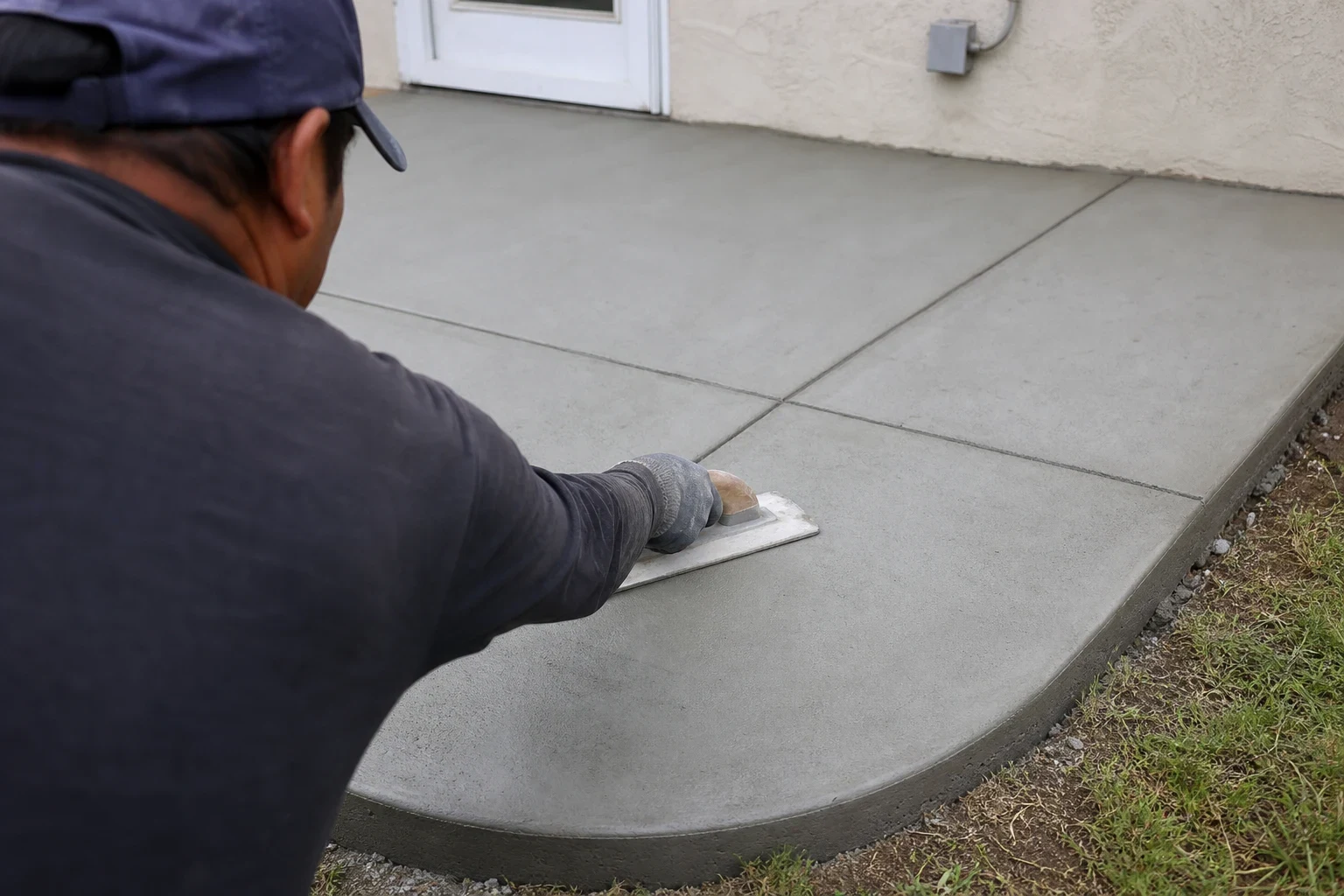
We place and finish the concrete in the texture you chose, from a simple broom finish to a smooth trowel. Control joints are cut so any shrinkage cracks follow a straight line rather than wandering across the slab.
Cleanup
Forms come out once the concrete has set, and we clear debris and wash down the work area before we leave.
Signs it's time for a new patio
Water pools near the house
If rain sits on the slab or runs back toward your walls, the slope is wrong. That usually means removing the old slab and pouring a new one with proper fall.
The slab has sunk or tilted
A patio that has dropped below the door threshold or tips toward one corner was likely built on poorly compacted fill.
Wide cracks with uneven edges
Cracks where one side sits higher than the other become trip hazards, and they often trace back to roots or shifting soil underneath.
Dirt, worn pavers or a patio that's too small
Sometimes nothing is failing. You just want a usable outdoor space that fits a table, a grill and a few chairs.
How your patio project runs
- 1
Phone call and visit
You tell us what you have in mind, and we set a time to see the yard. We look at grade, drainage, access for equipment and the condition of any existing slab.
- 2
Plain findings and a written estimate
We walk you through what we found and what it means for the job. The estimate lists each part of the work so you can see where the money goes.
- 3
Demolition and prep
Any old concrete is broken out and hauled off. We grade, compact the base and set forms, and we keep the mess confined to the work area.
- 4
Pour day
The concrete truck or pump arrives, and the crew places, levels and finishes the slab in one session. Plan on keeping people and pets off it while it sets.
- 5
Curing and final walk
After the forms come off, we walk the patio with you, go over curing care and answer any questions.
What moves the price of a patio
Every yard is different, so we price after we've seen yours. These are the things that make the biggest difference, and your written estimate will show each one separately.
- Size and thickness
- More square footage means more concrete, base rock and labor. A slab meant to hold a heavy built-in grill or a future cover needs extra thickness in places.
- Removal and grading
- Breaking out an old slab, hauling it away and correcting a poor grade all add time. A flat, open dirt area costs less to prep.
- Access
- If a truck can't reach the backyard, we may need a concrete pump or wheelbarrows through a side yard, which changes the labor involved.
- Finish and color
- A broom finish is the most straightforward. Integral color, exposed aggregate or stamped concrete patterns take more material and finishing time.
Patio questions we hear often
Something not covered here? (562) 442-1399
How soon can we use the new patio?
Light foot traffic is usually fine after a day or two. We suggest waiting about a week before moving heavy furniture or a grill onto it. Concrete keeps gaining strength for weeks, so gentle use early on helps.
Will my patio crack?
A few fine lines on the surface are part of how any slab behaves. As fresh concrete dries out, it pulls in slightly, and that tension has to release somewhere. We cut control joints so it shows up inside those straight grooves instead of across the open slab. Firm base prep and the right slope are what prevent the wide, uneven cracks that cause real trouble.
Can you pour over my old patio?
We check that during the visit, and in most cases we recommend removing it. Pouring over a cracked or sunken slab tends to carry the same problems up into the new one, and it raises the height at your door. We'll tell you plainly what we see.
Can the patio match our pool deck or driveway?
Yes. If you're also planning a pool deck, a walkway or a new driveway, we can choose a finish and color that ties them together. Planning them at the same time can also make scheduling simpler.
Is the work covered after you finish?
Yes. Our patio work comes with a 1-year warranty. We'll explain what it covers when we go over your estimate.
Let's look at your backyard first
Tell us what you'd like the space to do for you, and we'll set up a visit. You'll get honest findings and a clear written estimate before any work is scheduled.